

AI Infrastructure Architecture: A Practical Guide for Modern Enterprises
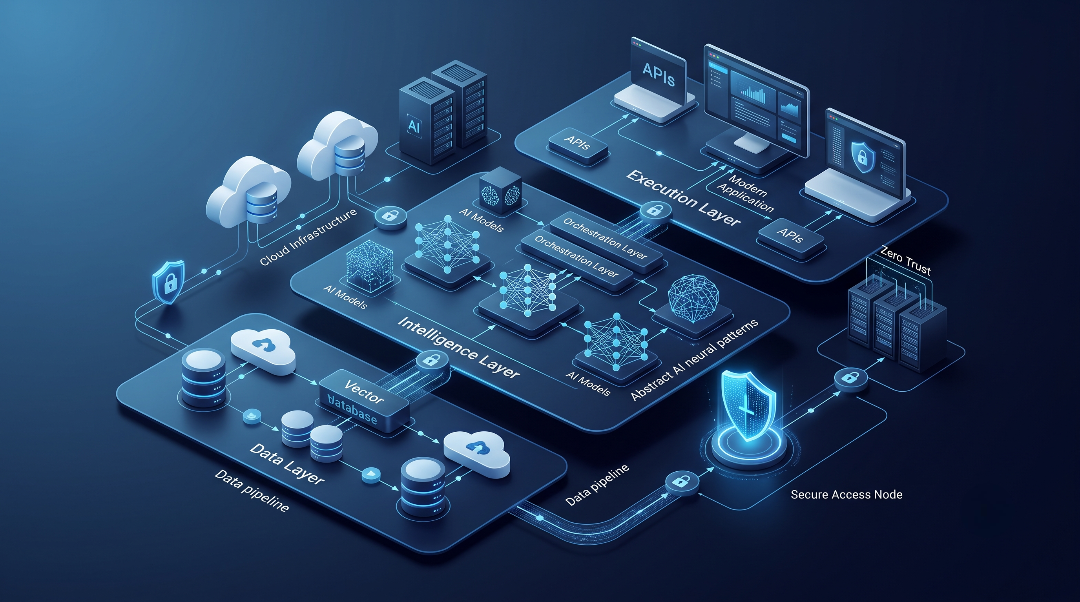
AI Infrastructure Architecture: A Practical Guide for Modern Enterprises
Imagine it's Monday morning. An employee asks the company’s AI assistant:
“Can you summarize our latest customer contracts?”
Within seconds, the AI searches internal documents, finds the relevant information, processes it, and provides an answer.
It feels simple.
But behind that answer is a complex system of data pipelines, vector databases, AI models, APIs, cloud infrastructure, and security controls.
That system is your AI infrastructure architecture.
As businesses move from AI experiments to real-world applications, having the right architecture is becoming just as important as choosing the right AI model.
What Is AI Infrastructure Architecture?
AI infrastructure architecture is the technical foundation that allows organizations to build, deploy, secure, and scale AI applications.
A modern enterprise architecture typically consists of three core layers:
Data Layer → Intelligence Layer → Execution Layer
Security, governance, and monitoring work across all three.
Let's look at each layer.
Data Layer: Pipelines & Vector Databases
AI is only as useful as the information it can access.
Enterprise data is usually spread across databases, PDFs, CRM systems, cloud storage, emails, and internal applications. AI infrastructure needs reliable pipelines to collect, clean, process, and organize this information.
A typical data flow looks like:
Data Sources → Data Pipeline → Processing → Embeddings → Vector Database
Vector databases are particularly useful for applications using Retrieval-Augmented Generation (RAG).
Instead of asking an AI model to remember every company document, RAG allows the system to retrieve relevant information when a user asks a question.
This helps AI applications provide more accurate and context-aware responses.
Intelligence Layer: Models & Orchestration
This is where the AI processes information and generates responses.
However, modern enterprise AI rarely depends on a single model.
A production application might use one model for simple tasks, another for complex reasoning, and specialized models for images, speech, or documents.
An orchestration layer helps manage these different workflows.
For example:
User Request → AI Router → Retrieval → Model → Tool/API → Response
This approach can improve performance while helping businesses control AI costs.
It also makes the architecture more flexible. Companies can adopt new models without rebuilding their entire AI application.
Execution Layer: APIs & Deployment
Once an AI system works in testing, the next challenge is putting it into production.
The execution layer connects AI capabilities with the applications employees and customers actually use.
It can include:
- APIs
- Cloud infrastructure
- Containers
- Kubernetes
- GPU servers
- Load balancers
- Serverless services
- Monitoring tools
A simple architecture might look like:
Application → API Gateway → AI Service → Model → Response
This separation makes it easier to manage authentication, scaling, monitoring, and security.
Scaling Considerations
An AI application that works for 100 users can behave very differently when 100,000 users start using it.
That's why scalability needs to be considered early.
Model Performance
Use the right model for the task instead of automatically choosing the largest model.
Infrastructure Scaling
Autoscaling, load balancing, caching, and queues can help handle changing demand.
Cost Management
Track token usage, GPU utilization, inference costs, and cost per request.
Observability
Monitor latency, errors, model performance, retrieval quality, and infrastructure health.
The goal isn't simply to build an AI system that works.
It's to build one that continues working when usage grows.
Zero-Trust Security Integration
Enterprise AI often works with sensitive business information.
That makes security a core part of AI infrastructure architecture—not something added at the end.
A Zero Trust approach means users, applications, and AI agents aren't automatically trusted.
Every request should be authenticated and authorized.
For AI systems, this is especially important when working with internal documents.
If an employee doesn't have permission to view a document, the AI assistant shouldn't be able to retrieve and summarize it for them.
Important security controls include:
- Identity and access management
- Encryption
- API authentication
- Role-based access
- Network segmentation
- Secrets management
- Audit logging
- Data-level permissions
In short, AI should follow the same security rules as the data it accesses.
AI Infrastructure Checklist
Before taking an AI application into production, ask:
- Is the data pipeline reliable?
- Is sensitive data protected?
- Is a vector database required?
- Are the right AI models being used?
- Is model orchestration in place?
- Can the infrastructure scale?
- Are APIs properly secured?
- Are AI costs being monitored?
- Is model performance measurable?
- Are Zero Trust principles implemented?
- Is there a disaster recovery plan?
If these questions don't have clear answers, the architecture may need more work before going into production.
How Aqxon Tech Approaches Enterprise AI Infrastructure
Building enterprise AI isn't just about selecting the latest model.
At Aqxon Tech, the focus is on creating AI foundations that connect data, models, applications, infrastructure, and security into a practical and scalable system.
A strong architecture should be designed around the organization's actual business requirements—not around technology for its own sake.
Whether the goal is implementing RAG, connecting AI to enterprise applications, improving AI deployment, or preparing infrastructure for scale, the underlying architecture plays a critical role in long-term success.
FAQs
What is AI infrastructure architecture?
AI infrastructure architecture is the combination of data systems, AI models, compute infrastructure, APIs, security, and deployment technologies that support enterprise AI applications.
What are the main layers of AI infrastructure?
The three main layers are the Data Layer, Intelligence Layer, and Execution Layer. Security, governance, and monitoring should span across all three.
Why are vector databases used in AI?
Vector databases help AI applications find information based on meaning rather than simply matching keywords. They're commonly used in RAG systems.
How can businesses reduce AI infrastructure costs?
Businesses can reduce costs by choosing models based on the task, optimizing prompts, caching repeated requests, monitoring token usage, and using smaller models where appropriate.
Why is Zero Trust important for enterprise AI?
Zero Trust helps ensure that users and AI systems only access the information and resources they are authorized to use. This is particularly important when AI applications work with sensitive enterprise data.
Final Thoughts
The AI model might be the most visible part of an enterprise AI system, but it's only one piece of the puzzle.
Behind every reliable AI application is infrastructure that moves the right data, selects the right model, delivers responses efficiently, and keeps everything secure.
At Aqxon Tech, we believe this foundation is what turns AI from an experiment into a practical business capability.
That's why AI infrastructure architecture deserves attention from the very beginning.
Build the foundation well, and your AI systems can scale with the business instead of becoming another expensive experiment.
Tagged in