


From AI Agent to Production-Ready System
87%
Recovery Rate
The Challenge
The initial AI prototype could understand requests and produce useful responses.
The problem appeared when we asked it to do real work.
A production system cannot simply generate an answer and stop.
It needs to understand the current state, decide what action to take, interact with external systems, verify what happened, and recover when something goes wrong.
A failed API call, outdated information, or unexpected response could cause the agent to make the next decision using an incorrect assumption.
The challenge was therefore to move from an impressive prototype to a system that could operate reliably and predictably in a real environment.
Strategic Approach & Architecture
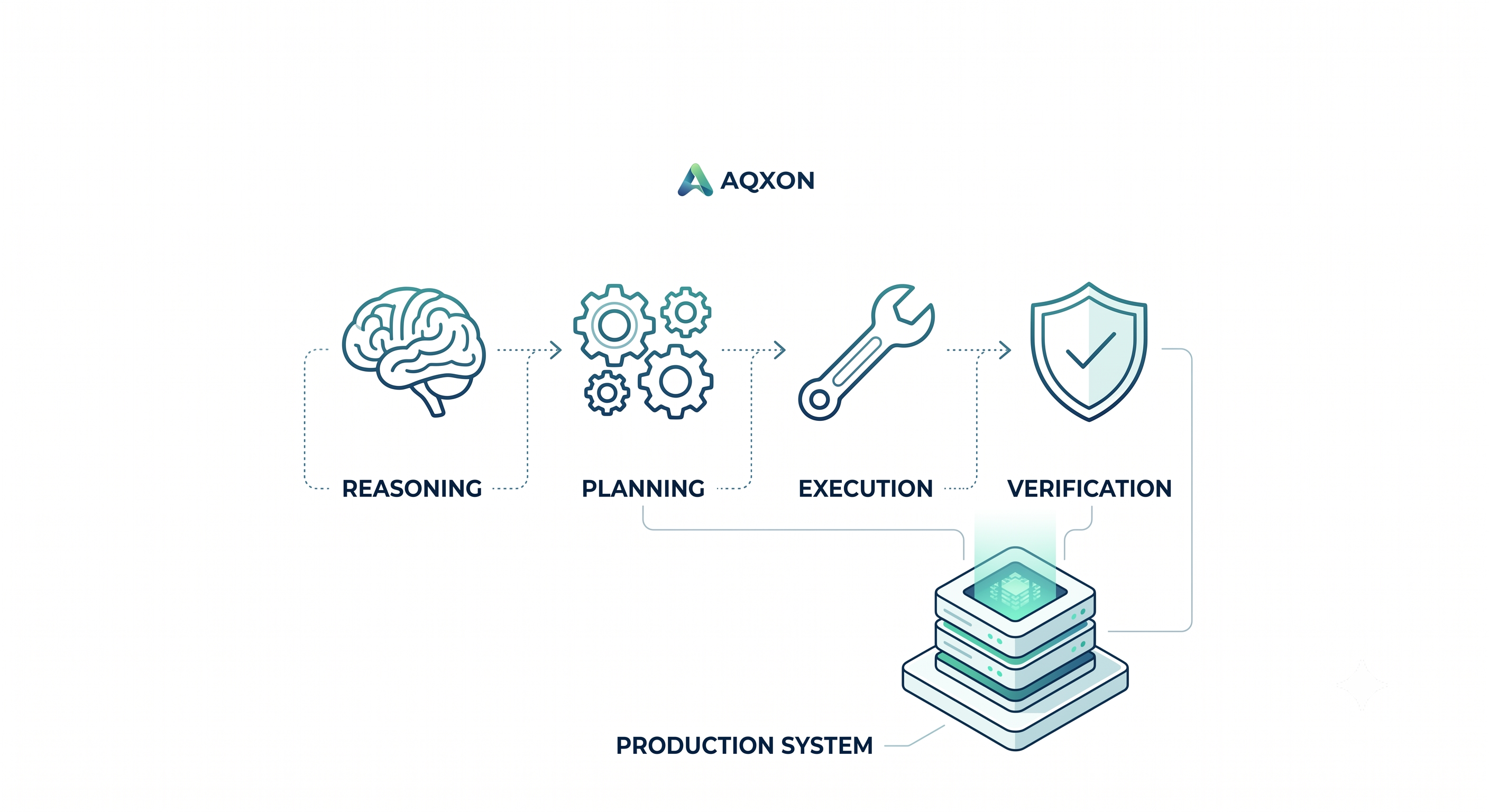
AQXON redesigned the architecture around controlled execution.
The system separated:
Reasoning → Planning → Execution → Verification
Each important action generated a traceable state that could be checked before the next action was taken.
The architecture also introduced:
• Context and state management
• Tool-level validation
• Execution receipts
• Retry controls
• Failure detection
• Human escalation
• Observability and audit trails
This allowed the system to distinguish between:
“The action failed.”
and
“We don't know whether the action succeeded.”
That distinction is critical when an AI system can create real-world side effects.
Engineering Implementation
AQXON engineered a production-oriented AI agent architecture that separates reasoning, planning, execution, and verification into controlled stages.
The system maintains state throughout multi-step workflows and allows agents to use external tools while applying validation before and after important actions.
We implemented execution receipts, retry controls, failure detection, and outcome verification to distinguish between a failed action and an action whose result is unknown.
The architecture also includes observability and human escalation paths, allowing uncertain situations to be identified and handled without requiring the agent to make an unsupported decision.
Measured Impact & Key Results
Applied Engineering Services
Achieve Similar Impact
Speak with our engineers to discover how we can architect a high-performance solution for your specific constraints.
Schedule Technical Review