

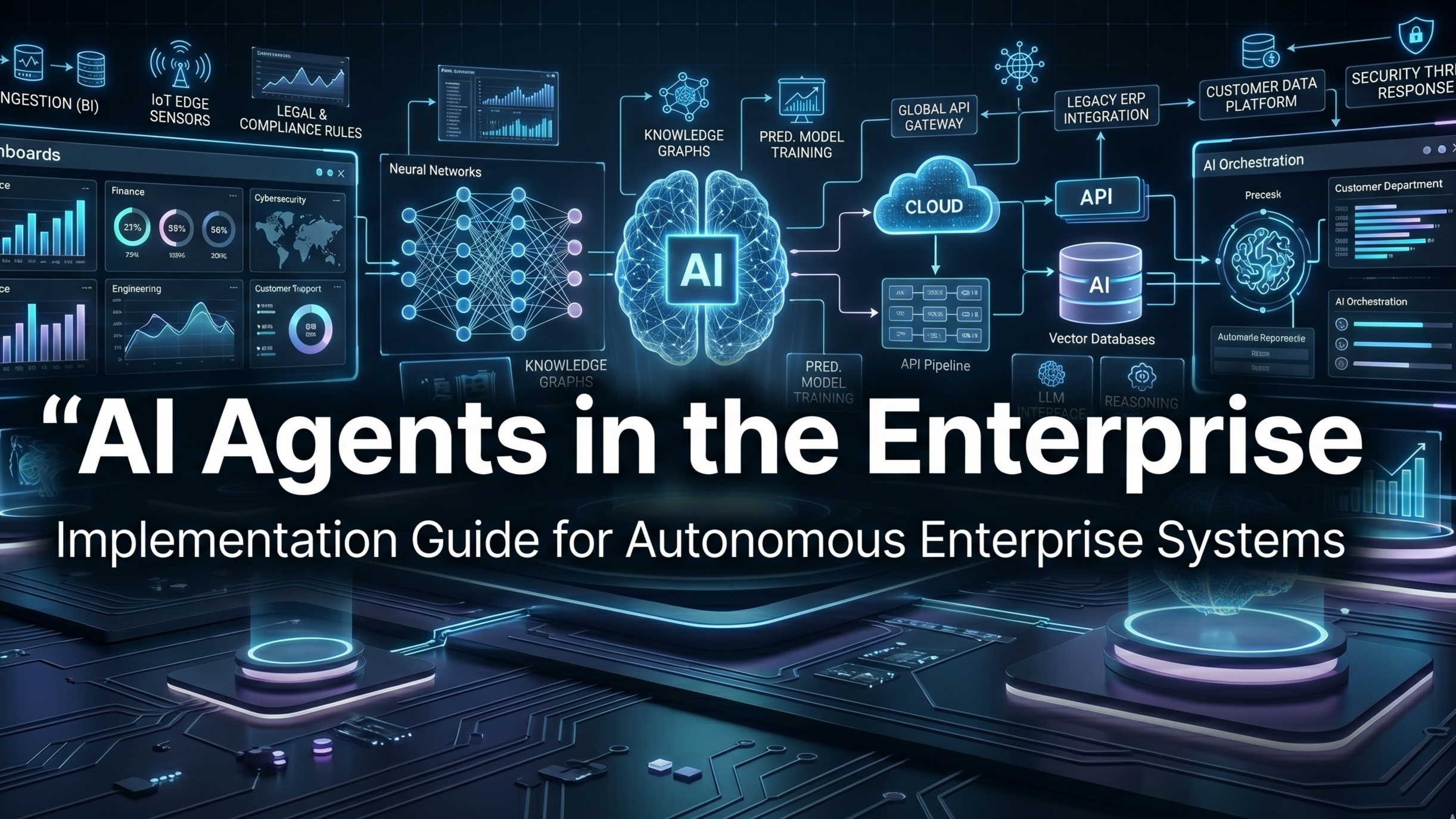
Most enterprise AI projects still stop at chatbots, internal copilots, or isolated automation experiments. The real shift is happening elsewhere. Businesses are now building AI agents that can execute tasks, retrieve internal knowledge, coordinate across systems, and assist teams with operational work that previously required multiple people.
This is where enterprise AI is heading next. Instead of using AI only for content generation, organizations are deploying AI systems that can support workflows across engineering, operations, customer support, finance, security, and internal knowledge management.
The companies seeing meaningful results are not treating AI as a standalone tool. They are integrating it directly into day-to-day operations, connecting large language models with enterprise data, workflow engines, APIs, memory systems, and governance layers.
This guide breaks down how AI agents work inside enterprise environments, how modern architectures are structured, where companies are getting measurable value, and what it takes to deploy these systems responsibly at scale.
Table of Contents
- What Are Autonomous AI Agents?
- Why Enterprises Are Investing in AI Agents
- Agent Architecture Explained
- Core Components of Enterprise AI Agents
- Use Cases Across Departments
- Multi-Agent Orchestration & Memory Systems
- Enterprise Deployment Strategy
- Security & Governance Considerations
- Enterprise Implementation Framework
- Enterprise-Level Insights
- FAQs
What Are Autonomous AI Agents?
Defining AI Agents in Enterprise Systems
AI agents are autonomous software systems capable of perceiving context, reasoning about goals, taking actions, using tools, and adapting based on outcomes.
Unlike traditional chatbots or static automation systems, enterprise AI agents can:
- Interpret business intent
- Access enterprise systems
- Retrieve organizational knowledge
- Execute workflows
- Coordinate with other agents
- Learn from interactions
- Maintain contextual memory
- Escalate intelligently to humans
The shift from “prompt-response AI” to “agentic AI systems” represents one of the most significant changes in enterprise software architecture since cloud computing.
Traditional AI vs Autonomous AI Agents
| Capability | Traditional AI | Enterprise AI Agents |
|---|---|---|
| Response Style | Reactive | Autonomous |
| Workflow Execution | Limited | Multi-step |
| Tool Usage | Minimal | Dynamic |
| Context Awareness | Session-only | Persistent memory |
| Decision-Making | Static | Adaptive |
| Collaboration | Single system | Multi-agent orchestration |
| Enterprise Integration | API-driven | Operationally embedded |
That distinction matters. Most business teams are no longer looking for systems that simply answer questions. They want systems that can actually help move work forward.
A customer support agent should not just draft a reply. It should retrieve account history, classify urgency, summarize prior conversations, suggest the next action, and escalate only when needed.
An engineering agent should not just generate code snippets. It should understand repositories, review pull requests, detect vulnerabilities, generate documentation, and assist with deployment workflows.
That operational layer is what separates enterprise AI agents from standard generative AI tools.
Why Enterprises Are Investing in AI Agents
The Enterprise Shift Toward Agentic AI
Enterprise leaders are rapidly adopting AI agents because they address three major operational challenges:
1. Operational Complexity
Modern organizations operate across fragmented systems:
- CRMs
- ERPs
- Internal knowledge bases
- Ticketing systems
- Cloud platforms
- Communication tools
AI agents unify execution across disconnected enterprise infrastructure.
2. Knowledge Bottlenecks
Most enterprise knowledge remains trapped in:
- PDFs
- Emails
- Slack conversations
- Internal documentation
- Legacy systems
AI agents powered by retrieval architectures can operationalize organizational intelligence.
3. Productivity Scaling
Traditional automation handles repetitive workflows. AI agents handle cognitive workflows:
- Research
- Analysis
- Decision support
- Process coordination
- Strategic recommendations
This creates a new category of “augmented operational intelligence.”
Agent Architecture Explained
The Core Architecture of Enterprise AI Agents
Modern AI agent systems typically include five foundational layers:
1. Reasoning Layer
The reasoning layer is powered by large language models (LLMs) capable of:
- Planning
- Chain-of-thought reasoning
- Tool selection
- Goal decomposition
- Decision generation
This layer determines what actions should occur next.
2. Tool Execution Layer
Enterprise agents require access to operational systems such as:
- Salesforce
- SAP
- Jira
- Slack
- Databases
- Internal APIs
- Cloud infrastructure
The tool layer enables agents to execute real-world actions.
3. Memory Layer
Enterprise-grade agents require memory systems for:
- Long-term organizational context
- User preferences
- Workflow history
- Multi-session continuity
- Retrieval-augmented generation (RAG)
Without memory systems, agents become stateless and unreliable.
4. Orchestration Layer
Orchestration systems coordinate:
- Multi-agent workflows
- Task delegation
- Dependency management
- State synchronization
- Failure recovery
This layer becomes critical at enterprise scale.
5. Governance & Security Layer
Enterprise AI requires:
- Access controls
- Audit logs
- Compliance enforcement
- Explainability
- Human approval systems
- Data governance
Responsible AI implementation is now a business requirement rather than an optional enhancement.
Core Components of Enterprise AI Agents
Retrieval-Augmented Generation (RAG)
RAG systems allow agents to retrieve enterprise knowledge dynamically before generating responses.
Benefits include:
- Reduced hallucinations
- Real-time knowledge access
- Improved factual accuracy
- Enterprise-specific intelligence
RAG is foundational for production-grade enterprise AI.
Vector Databases
Enterprise memory systems commonly use vector databases for semantic retrieval:
- Pinecone
- Weaviate
- Chroma
- Milvus
- pgvector
These systems store embeddings representing organizational knowledge.
Planning Systems
Advanced agents use planning frameworks to:
- Break objectives into subtasks
- Prioritize actions
- Re-evaluate strategies dynamically
- Recover from failures
Planning is essential for autonomous execution.
Multi-Agent Systems
Large enterprise workflows increasingly rely on specialized agents:
- Research agents
- Analyst agents
- Coding agents
- Security agents
- Workflow coordinators
This distributed architecture improves scalability and reliability.
Use Cases Across Departments
Customer Support
AI Agents in Enterprise Customer Operations
One of the fastest areas of adoption is enterprise customer operations.
Large support teams are using AI agents to reduce response times, automate repetitive workflows, and improve context retrieval across fragmented systems. Instead of forcing support teams to manually search through CRMs, ticket histories, PDFs, and internal documentation, AI agents can retrieve relevant information instantly and prepare actionable responses.
Several enterprise platforms are already moving in this direction. Customer support ecosystems are increasingly integrating retrieval systems, workflow automation, and autonomous task handling into service operations.
AI agents can:
- Resolve tickets autonomously
- Retrieve customer history
- Generate contextual responses
- Escalate intelligently
- Perform sentiment analysis
Enterprise Impact
- Reduced resolution time
- 24/7 support operations
- Lower support costs
- Improved customer satisfaction
Software Engineering
AI Agents in Modern Engineering Workflows
Software engineering teams are also seeing major operational gains.
Tools like GitHub Copilot, AI-powered code review systems, and autonomous engineering assistants are changing how development teams manage repetitive work. Engineering organizations are experimenting with AI agents that can review pull requests, generate test coverage, identify vulnerabilities, monitor deployments, and assist with debugging workflows.
In larger environments, these systems are becoming part of the broader engineering lifecycle rather than isolated developer tools.
Engineering organizations use AI agents for:
- Code generation
- Test automation
- Documentation
- DevOps workflows
- Security analysis
Agentic software engineering is becoming a major competitive advantage.
Finance & Operations
AI agents support:
- Financial forecasting
- Invoice processing
- Procurement automation
- Risk analysis
- Operational reporting
Autonomous financial intelligence reduces manual coordination overhead.
Human Resources
HR applications include:
- Resume screening
- Candidate matching
- Employee onboarding
- Internal knowledge assistance
- Workforce analytics
Cybersecurity
Security agents can:
- Monitor threats continuously
- Analyze anomalies
- Investigate incidents
- Automate remediation workflows
- Coordinate security responses
AI-powered security operations are becoming essential for modern enterprises.
Multi-Agent Orchestration & Memory Systems
Why Orchestration Matters
Single-agent systems struggle with enterprise-scale complexity.
Modern enterprise architectures increasingly use:
- Supervisor agents
- Specialized worker agents
- Shared memory systems
- Workflow state management
This creates scalable operational intelligence systems.
Enterprise Memory Architectures
Short-Term Memory
Used for:
- Current workflow context
- Active conversations
- Session continuity
Long-Term Memory
Stores:
- Organizational knowledge
- Historical workflows
- Business processes
- User interactions
Episodic Memory
Tracks:
- Past actions
- Decisions
- Outcomes
- Feedback loops
Shared Context Systems
Shared memory architectures enable agents to collaborate across workflows.
Example:
- Research agent gathers insights
- Analyst agent structures findings
- Execution agent performs actions
- Audit agent validates compliance
This collaborative intelligence model is becoming central to enterprise AI transformation.
Enterprise Deployment Strategy
Phase 1: AI Readiness Assessment
Before deployment, enterprises should evaluate:
- Data maturity
- Infrastructure readiness
- API accessibility
- Security posture
- Governance requirements
Organizations that skip readiness assessments often encounter scaling failures later.
Phase 2: Identify High-Impact Workflows
Best initial use cases:
- High repetition
- Knowledge-heavy
- Multi-system coordination
- Human bottlenecks
- Expensive manual workflows
Avoid deploying autonomous agents first in high-risk mission-critical systems.
Phase 3: Build Human-in-the-Loop Systems
Enterprise AI agents should initially operate with:
- Human approval layers
- Escalation workflows
- Confidence thresholds
- Monitoring systems
This reduces operational and compliance risks.
Phase 4: Progressive Autonomy
Mature enterprises gradually increase autonomy:
- AI assistance
- AI recommendations
- Semi-autonomous workflows
- Full autonomous orchestration
This staged deployment model improves adoption and trust.
Security & Governance Considerations
Enterprise AI Security Risks
AI agents introduce new attack surfaces:
- Prompt injection
- Data leakage
- Unauthorized actions
- Tool misuse
- Model manipulation
- Memory poisoning
Security architecture must evolve alongside agent capabilities.
Governance Framework
Identity & Access Management
Agents require:
- Role-based permissions
- API authentication
- Action restrictions
- Zero-trust enforcement
Auditability
Enterprise AI systems should maintain:
- Execution logs
- Decision trails
- Tool usage history
- Model outputs
- User interactions
Auditability becomes essential for compliance and operational trust.
Explainability
Enterprise leaders need visibility into:
- Why actions occurred
- Which data sources were used
- How decisions were generated
Regulatory Compliance
Depending on industry requirements:
- GDPR
- HIPAA
- SOC 2
- ISO 27001
- AI governance regulations
must be integrated into deployment architecture from the beginning.
Enterprise Implementation Framework
A Practical Enterprise AI Agent Framework
Step 1: Define Strategic Objectives
Successful enterprises focus on:
- Productivity gains
- Operational acceleration
- Cost reduction
- Decision augmentation
- Knowledge accessibility
Avoid deploying AI agents without measurable business outcomes.
Step 2: Build a Unified Knowledge Layer
Enterprise AI depends heavily on data quality.
Critical components include:
- Document ingestion pipelines
- Semantic indexing
- Metadata enrichment
- Real-time synchronization
- Access-aware retrieval
Step 3: Establish AI Infrastructure
Modern enterprise stacks commonly include:
- LLM gateways
- Vector databases
- Orchestration frameworks
- Monitoring systems
- Security middleware
- Observability platforms
Step 4: Deploy Controlled Pilots
Pilot deployments should measure:
- Accuracy
- Productivity impact
- User adoption
- Workflow completion rates
- Failure frequency
Operational telemetry is critical.
Step 5: Scale Through Governance
Enterprise AI maturity requires:
- AI operations teams
- Governance councils
- Risk management frameworks
- Continuous monitoring
- Model lifecycle management
This transforms AI from experimentation into operational infrastructure.
Enterprise-Level Insights
The Rise of Compound AI Systems
A growing number of enterprises are realizing that a single model is rarely enough for production-grade operations.
Real-world enterprise environments are messy. Systems are fragmented. Data is inconsistent. Workflows involve approvals, dependencies, permissions, and changing business rules.
That is why modern enterprise AI architectures increasingly combine multiple systems together:
- Language models
- Retrieval systems
- Memory layers
- Workflow orchestration engines
- Specialized domain agents
- Security and governance controls
This layered approach is often more reliable than depending on one monolithic model for everything.
The future of enterprise AI is not a single model.
Organizations are building:
- Compound AI architectures
- Multi-agent ecosystems
- Hybrid reasoning systems
- Specialized domain agents
These systems outperform isolated AI implementations.
AI Agents Will Become Operational Infrastructure
AI agents are evolving into:
- Digital employees
- Autonomous operational systems
- Organizational intelligence layers
This shift will fundamentally change:
- Enterprise software
- Workforce productivity
- Knowledge management
- Business operations
Human + AI Collaboration Will Define Competitive Advantage
The most successful enterprises will not replace humans.
They will create systems where:
- Humans provide strategy
- AI agents execute workflows
- Teams focus on high-value thinking
- Operational friction disappears
This “human + AI” model aligns closely with the next generation of applied AI transformation strategies being developed by advanced AI research and implementation organizations.
For enterprises exploring applied AI transformation, research-driven implementation approaches from AQXON and applied deployment ecosystems such as AQXON Tech represent the emerging convergence between frontier AI research and enterprise execution infrastructure.
FAQs
What are AI agents in enterprise environments?
AI agents in enterprise environments are autonomous AI systems capable of reasoning, retrieving knowledge, using tools, executing workflows, and coordinating actions across enterprise systems with minimal human intervention.
How are AI agents different from chatbots?
Traditional chatbots primarily generate responses. AI agents can plan actions, access enterprise systems, maintain memory, execute workflows, and autonomously complete tasks.
What industries benefit most from enterprise AI agents?
Industries with complex workflows and large knowledge systems benefit most, including:
- Finance
- Healthcare
- Manufacturing
- Technology
- Logistics
- Enterprise SaaS
- Customer support operations
What is multi-agent orchestration?
Multi-agent orchestration is the coordination of multiple specialized AI agents working together through shared memory, task delegation, workflow synchronization, and centralized governance.
Are enterprise AI agents secure?
Enterprise AI agents can be secure when implemented with:
- Role-based access control
- Audit logging
- Human approval workflows
- Encryption
- Governance systems
- Prompt injection defenses
- Compliance frameworks
What is the future of AI agents in enterprises?
Enterprise AI is moving toward operational systems where autonomous agents support real business workflows across departments, infrastructure, and knowledge systems.
Over the next few years, companies will likely shift from isolated AI assistants toward coordinated AI ecosystems that combine reasoning, memory, orchestration, retrieval, and workflow execution.
The organizations that succeed will be the ones that combine strong governance with practical operational deployment rather than chasing short-term AI hype.
How should enterprises start implementing AI agents?
The best starting point is usually a narrow operational workflow with measurable outcomes.
Instead of trying to automate entire departments immediately, enterprises should begin with:
- Repetitive operational tasks
- Internal knowledge retrieval
- Workflow coordination
- Customer support automation
- Engineering productivity workflows
Small controlled deployments create better long-term results than aggressive enterprise-wide rollouts.
Enterprise AI is moving toward fully orchestrated operational intelligence systems where autonomous agents collaborate with humans to execute workflows, manage knowledge, and optimize business operations at scale.
Related Enterprise AI Resources
Enterprises evaluating AI transformation typically move through several stages, from experimentation to operational deployment.
If your organization is exploring enterprise AI adoption, these areas are usually the highest-impact starting points:
- What is AI Automation? Transforming Business Operations for 2026 and Beyond
- Enterprise AI Trends 2026: The Executive Guide to Scalable AI
AQXON focuses on advanced AI research and enterprise-scale AI systems, while AQXON Tech applies these research capabilities into practical business workflows, operational systems, and applied AI experiences.
Explore more:
- aqxon.com (Research Labs)
- Applied Artificial Intelligence
Tagged in